Advanced Knee Solutions Guided by Precision and Expertise
Knee pain that interferes with staying active or performing everyday tasks can significantly impact your quality of life. Our orthopedic team offers comprehensive knee care—from conservative treatment options to advanced knee replacement—focused on relieving pain, restoring function, and supporting recovery through advanced technology and personalized planning.

Meet Your Surgeon
Robert Limoni, MD — Orthopedic Surgeon
Dr. Limoni is committed to bringing advanced technology and thoughtful innovation into knee care. His approach emphasizes personalized care and intentional planning, with a focus on achieving long-lasting results, optimal recovery, and improving overall quality of life. Whether recommending surgical or non-surgical treatment, Dr. Limoni prioritizes individualized decision-making to help each patient achieve the best possible outcome with an emphasis on long-term success.
Patients work with Dr. Limoni for:
- comprehensive evaluation and clear diagnosis
- non-surgical treatment options when appropriate
- advanced knee replacement solutions when conservative care is no longer effective
- muscle-sparing techniques in eligible patients
- technology-supported precision, including augmented reality guidance

What to Expect
We take a structured, patient-centered approach to care—guiding you through each step with clarity and intention.
1) Consultation & Diagnosis
We begin with a comprehensive evaluation, reviewing your symptoms, physical exam findings, medical history, and imaging when appropriate to accurately identify the source of pain and functional limitations.
2) Personalized Plan
Based on your evaluation, you’ll receive a customized care plan that may include conservative treatment options or surgical considerations, aligned with your goals, lifestyle, and timeline.
3) Surgical Planning (If Needed)
When knee replacement is recommended, preoperative planning focuses on alignment, implant selection, and the appropriate use of advanced technology to support precision and consistency during surgery.
4) Recovery & Follow-Up
Postoperative care includes clear recovery guidance, scheduled follow-up visits, and rehabilitation recommendations designed to support safe progress, restore mobility, and promote long-term knee function.
Common Knee Conditions
We evaluate a wide range of knee conditions and pain generators including:
- osteoarthritis
- cartilage wear or degeneration
- meniscus tears and degeneration
- stiffness and reduced range of motion
- swelling and activity-related inflammation
- ligament injuries (ACL, PCL, MCL, LCL)
- bursitis and soft tissue irritation
- Persistent pain after previous procedures
When to Consider an Evaluation
Many patients seek a knee consultation when they experience:
- Severe knee pain that limits walking, climbing stairs, or other daily activities
- pain at night or pain while resting
- difficulty bending or fully straightening the knee
- Chronic swelling and stiffness
- declining activity tolerance or function
- symptoms that persist despite conservative care
Treatment Options
We offer a full spectrum of knee care—from conservative treatment to advanced surgical solutions. Recommendations are based on your diagnosis, imaging findings, anatomy, activity level, and long-term goals.
Non-Surgical Treatment Options
Conservative care may include activity guidance, strengthening excercises, physical therapy, medication or anti-inflammatory recommendations, bracing, and targeted injection therapies when appropriate—focused on improving function and reducing pain.
Knee Replacement Procedures
When conservative care is no longer effective, knee replacement may be considered. Dr. Limoni offers several approaches based on diagnosis, anatomy, and goals—including total, partial (unicompartmental), and revision knee replacement.
Technology-Assisted Knee Replacement
When appropriate, advanced technology may be incorporated to enhance surgical planning and accuracy. This may include augmented reality navigation (ARVIS®) to support precise alignment and implant positioning based on your individual anatomy.
Jiffy Knee™ (Muscle-Sparing Option)
For eligible patients, Dr. Limoni offers Jiffy Knee™, a muscle-sparing knee replacement technique designed to reduce disruption to surrounding soft tissues while restoring joint function. Suitability is determined during your evaluation.
Understanding your knee replacement options
When knee replacement is recommended, the specific approach is determined by where arthritis is present, the condition of the joint, and your individual goals:
- Partial (Unicompartmental) Knee Replacement — may be considered when arthritis is limited to one compartment of the knee
- Total Knee Replacement — may be recommended when arthritis affects multiple compartments or the joint is more broadly damaged
- Revision Knee Replacement — may be needed if a previous knee replacement has worn, loosened, or failed
- Jiffy Knee™ — a muscle-sparing technique that may reduce soft tissue disruption in eligible patients
- Augmented Reality Navigation Total Knee Replacement —utilizes ARVIS® Augmented Reality System to assist with real-time visualization, alignment assessment, and implant positioning during knee replacement surgery
Each option has specific indications and considerations. Dr. Limoni will recommend the most appropriate approach based on your diagnosis, anatomy, and goals.
Innovative Technique
Jiffy Knee™
Jiffy Knee™ joint replacement is a muscle-sparing surgical technique designed to replace the knee joint with less trauma to the surrounding tissues. Compared to traditional knee replacement surgery, this approach is intended to reduce postoperative pain and support a faster recovery.
In traditional knee replacement, an incision is typically made along the front of the knee and the quadriceps tendon is cut, which can lengthen recovery. With the Jiffy Knee™ technique, specialized instruments are used to work around the muscle rather than cutting through it. The incision is positioned more toward the side of the knee to minimize disruption to muscles, tendons, and ligaments while still allowing precise placement of the knee implant.
Jiffy Knee™ joint replacement may be recommended for individuals with knee arthritis or knee damage that has not responded to conservative treatment. Candidacy depends on overall health, knee anatomy, alignment, and the severity of joint damage.
Potential benefits of Jiffy Knee™
- Reduced postoperative pain with less reliance on narcotic medication
- Faster recovery, with many patients walking within hours
- Smaller incision and less visible scarring
- Minimal muscle trauma with preservation of the quadriceps tendon
- Lower risk of complications such as infection or blood loss
- Many patients return home the same day or within 24 hours
Individual results vary. Your surgeon will determine whether this technique is appropriate based on your specific condition and goals.
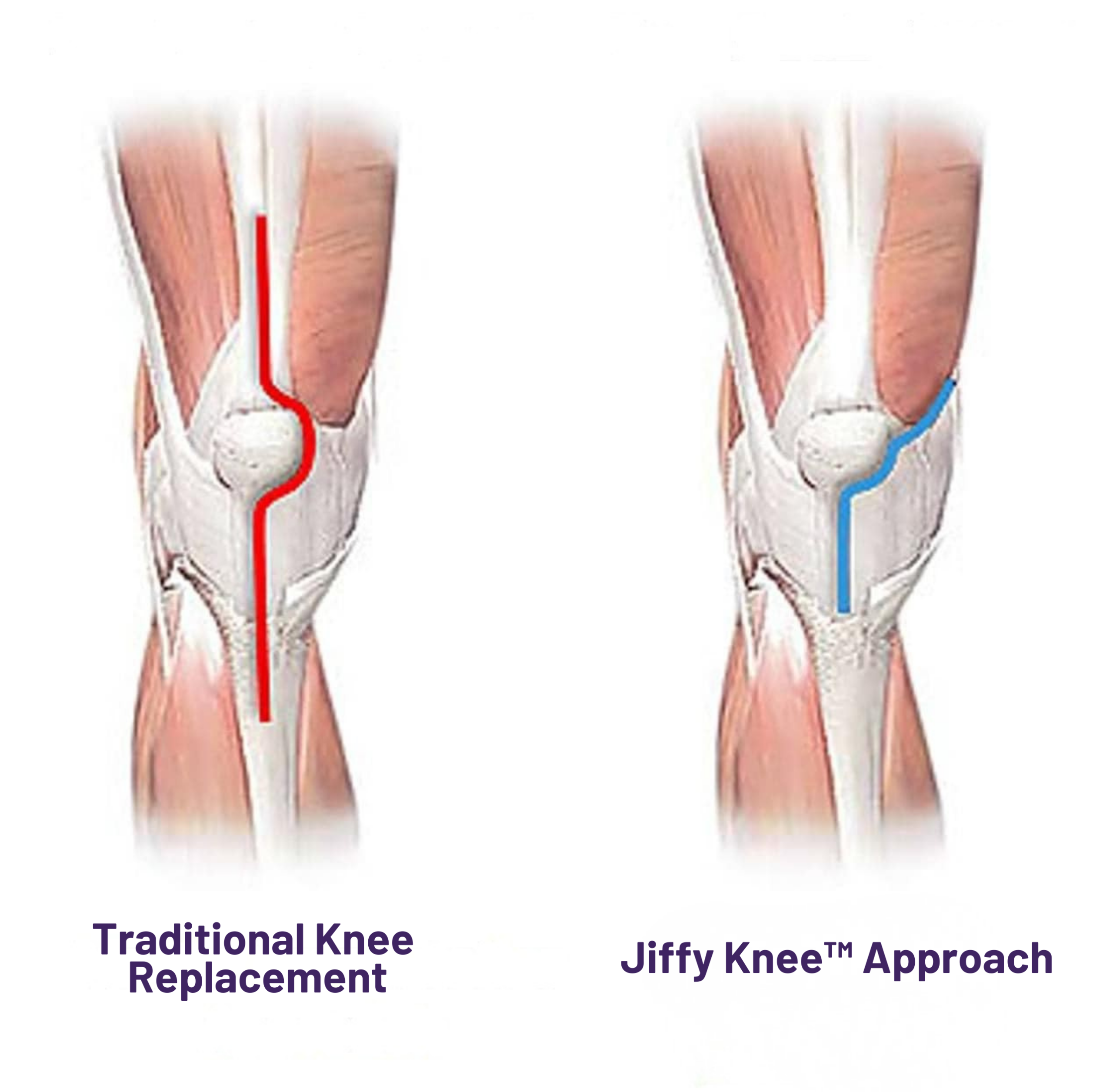
Comparison of incision placement in traditional knee replacement versus the muscle-sparing Jiffy Knee™ technique.
Hear from one of Dr. Limoni’s patients who underwent a traditional knee replacement on one knee and the Jiffy Knee™ procedure on the other, discussing key differences in recovery and outcomes.
Advanced Technology
Augmented Reality Navigation (ARVIS®)
Augmented reality navigation is an advanced, AR-based surgical guidance system that Dr. Limoni may use during select knee replacement procedures, including Jiffy Knee™. Using FDA-approved ARVIS® technology, the system provides real-time, hands-free guidance through infrared cameras and 3D tracking, displaying key alignment and positioning information directly within the surgeon’s field of view during surgery.
This technology allows Dr. Limoni to assess alignment, implant positioning, and soft-tissue balance throughout the procedure, supporting accurate, consistent placement tailored to each patient’s anatomy. Unlike traditional robotic systems, ARVIS® is fully surgeon-controlled and is designed to enhance both precision and efficiency—often without the need for preoperative scans or additional radiation exposure.
Postoperative Remote Monitoring
As part of his commitment to innovation and advanced postoperative care, Dr. Limoni may use InkWell temporary monitoring tattoos following knee replacement. InkWell is a remote therapeutic monitoring system that uses a temporary skin “tattoo” and paired app to help track recovery data such as swelling, temperature, and range of motion. Applied immediately after surgery, the tattoo and app system can help patients and clinicians understand healing progress between visits and support timely adjustments in recovery plans.
Not every patient requires technology-assisted suregry or remote monitoring. Dr. Limoni will discuss whether these tools are appropriate for your care plan.

ARVIS® augmented reality navigation may support real-time alignment and implant positioning during select knee replacement procedures.
Hear from one of Dr. Limoni’s patients as she talks about her Jiffy Knee™ surgery and how InkWell remote monitoring supported her recovery.
Frequently Asked Questions
How do I know if I’m a candidate for Jiffy Knee™?
Candidacy depends on anatomy, alignment, the pattern and severity of arthritis, and medical history. Dr. Limoni will review your evaluation and imaging to determine whether a muscle-sparing technique is appropriate.
Does everyone need augmented reality navigation?
No. AR guidance is one tool that may be used when appropriate. Dr. Limoni will explain whether AR navigation is recommended for your case and how it fits into your surgical plan.
Will surgery be recommended at my first visit?
Not always. We carefully evaluate your symptoms, function, and imaging when needed, and discuss all appropriate treatment options to determine the right approach for your individual needs.
Do you accept insurance?
We accept most insurance providers. You can view a list of our accepted plans here . Our team is available by phone to help verify coverage and answer insurance questions before your visit.
What is recovery like after knee replacement?
Recovery varies by patient, but preparation and education are key. Dr. Limoni leads a comprehensive recovery program, including Joint Camp, which walks patients through each phase of recovery before surgery even takes place. This structured approach helps patients understand expectations, therapy progression, and postoperative care in advance.
Learn more about the recovery process
Watch the Joint Camp presentation on YouTube
